The benefits of plants in the office include improved air quality, better moods, increased productivity, and a more stylish, inviting space.
The best office plants are low-maintenance and adaptable to indoor conditions. Top picks include snake plants, ZZ plants, pothos, and succulents.
If you’re choosing plants for an office with no windows, go for varieties like pothos and ZZ plants that thrive in low-light environments.
Avoid high-maintenance plants like ferns, orchids, and fiddle-leaf trees, which can struggle in typical office conditions.
Think creatively about placement. Use tall plants in corners, build a living wall, or mix a few types of greenery throughout the space to liven up your workstations without overwhelming them.
Whether designing a new office space or looking for ways to revamp your new workstations, office plants are a great way to add unique design elements.
Plus, plants are highly beneficial in the workplace and can complement your office furniture nicely.
Keep reading to find out how to pick the best plant for your office and which plants to avoid.
The Benefits of Office Plants
There are many reasons to love indoor plants, making them popular in homes, offices, and other businesses. Indoor plants are certainly beautiful to look at and offer numerous benefits.
Office plants can be an extremely beneficial addition to any office space.
Plants Improve Air Quality
Research into how plants can purify indoor environments has found that many types of indoor plants help improve air quality.
One study analyzed various plants to evaluate their ability to remove pollutants from indoor air. The study found that several plants can absorb harmful toxins like benzene and formaldehyde.
These plants include:
Aloe vera
Peace lilies
Orchids
Rubber plants
English ivy
Areca palm
The snake plant, for example, can remove nitrogen oxide, benzene, xylene, and trichloroethylene. When studying these plants, researchers found that the oxygen concentration in the room increased and carbon dioxide decreased over a set period.
Adding these plants to your workstations can help provide cleaner air for your office and reduce employees’ potential for getting sick.
They Can Increase Positivity
Office plants can also improve your employees’ moods. Knowing how to incorporate nature into office designs and match office furniture can help people in your office feel more connected to nature, which is soothing and relaxing.
Plants can also improve how you feel because they regulate things like humidity in the air. Something as simple as this can help increase positivity and improve moods, leading to a more positive and enjoyable work environment.
Plants Help Improve Productivity
Research has shown that office plants can significantly increase employees’ satisfaction with their workspace, improve concentration levels, and increase engagement with their work. When employees are satisfied in their office, they’re more likely to concentrate and be productive.
If you’re looking for ways to encourage your employees to be more productive or increase efficiency, a combination of new workstations and plants may be the answer.
They Are Great Decorations
If nothing else, plants can accessorize interior spaces. There are many ways to incorporate plants visually and aesthetically.
Plants can even look like art, depending on how they’re arranged. They can be a focal point or give people something to look at while lounging in comfortable office furniture.
Filling your office or workspace with plants can make the area more stylish and enjoyable.
4 Best Indoor Plants for Offices
Given the benefits of indoor plants in workstations, it only makes sense that you’d want to incorporate some into your office space.
With so many different types of indoor plants, how do you know what plant is best for an office?
Some indoor plants are higher maintenance than others, so the best office plants are easy to care for and survive in many environments.
1. Snake Plant
Scientifically known as Sansevieria, snake plants are one of the best options for office plants. They’re extremely low maintenance, and their green and yellow sword-like leaves will add a unique natural element to any office design while filtering toxins out of the air.
Office environments are often difficult for plants to grow in, though snake plants are nearly indestructible and actually thrive on neglect.
Snake plants grow best when ignored. They can go long periods without being watered, and infrequent watering actually helps prevent root rot. Snake plants are extremely versatile, so they can grow in almost any soil type.
Snake plants can tolerate various temperatures and humidity levels, so they’ll do well in any office atmosphere. This type of plant thrives in nearly any lighting situation, so whether it’s placed in front of a window or tucked into a dark corner of your cubicle, your snake plant will work with what it gets. Just be sure not to place it in direct sunlight, as the direct sun will dry the leaves and kill the plant.
Overall, snake plants are a great choice for most office spaces because they’re low maintenance and easy to please.
2. ZZ Plant
Zamioculcas zamiifolia, or ZZ plant for short, is another extremely low-maintenance plant that thrives on being forgotten. Though they grow slowly, ZZ plants can grow up to two feet tall and have beautiful wide, dark green leaves. Originating in Africa, these plants are drought tolerant and can handle a few missed waterings.
Like snake plants, ZZ plants tolerate various types of light, soil, and temperatures. ZZ plants are well-known as low-light plants, which makes them an ideal choice for office workstations with limited natural light.
Brighten up a dark room with a ZZ plant and simultaneously benefit from its air-filtering abilities.
ZZ plants are attractive plants that will certainly add to any space. One thing to keep in mind, however, is that ZZ plants are toxic to pets and people if ingested. While this shouldn’t be a concern if your office is for adults only, it may not be an excellent plant for workspaces with kids or pets.
3. Pothos
If your office has little to no natural light and you want to incorporate office plants, no light is no problem for pothos. Pothos are notorious for growing well under fluorescent lighting because they don’t require sunlight. Sunlight will help them grow bigger and fuller leaves, but they grow just fine in low light.
Pothos are pretty low maintenance in many other ways as well. They are amenable to most soil types and do well with intermittent watering. Pothos also appreciate humidity, though dry air is no problem.
Pothos are trailing plants, which means their glossy, variegated foliage drapes down over the pot they’re planted in. These plants can grow at impressive rates and look great in a hanging pot or placed somewhere high so the leaves can trail down. Additionally, pothos plants are extremely easy to propagate, so you can grow new plants from one pothos.
4. Succulents
If you’re looking for the best plants for office window sills, look to succulents. While most indoor plants will dry out when placed in direct sunlight, succulents prefer bright, warm environments.
Bright windowsills in south-facing rooms get a lot of direct sunlight, making them ideal for succulents. If your office has many windows in general, place some succulents where they’ll be able to soak up the natural light.
Succulents are generally a great office plant because they’re low-maintenance, only requiring infrequent, small amounts of water. You’ll also find numerous types of succulents, allowing you to add variety to your plant displays.
4 Office Plants to Avoid
The best plants for office spaces are typically low maintenance. As such, the worst office plants tend to be high maintenance, making caring for and keeping them alive more difficult in an office setting.
Unless you have the time and effort necessary to care for these four plants, try to avoid them.
1. Ferns
Ferns are well-known and easily recognizable plants in both indoor and outdoor spaces. While their beauty makes them desirable for indoor spaces and they can complement office furniture well, they’re pretty high maintenance and difficult to keep happy.
Ferns can be dramatic and quickly tell you when they’re unhappy. Humidity is necessary for these plants — without adequate humidity, their leaves will quickly dry out and crumble away. Once a fern begins drying out, it’s difficult to revive it.
Since ferns have a high need for humidity and are difficult to please, they’re typically not ideal for an office.
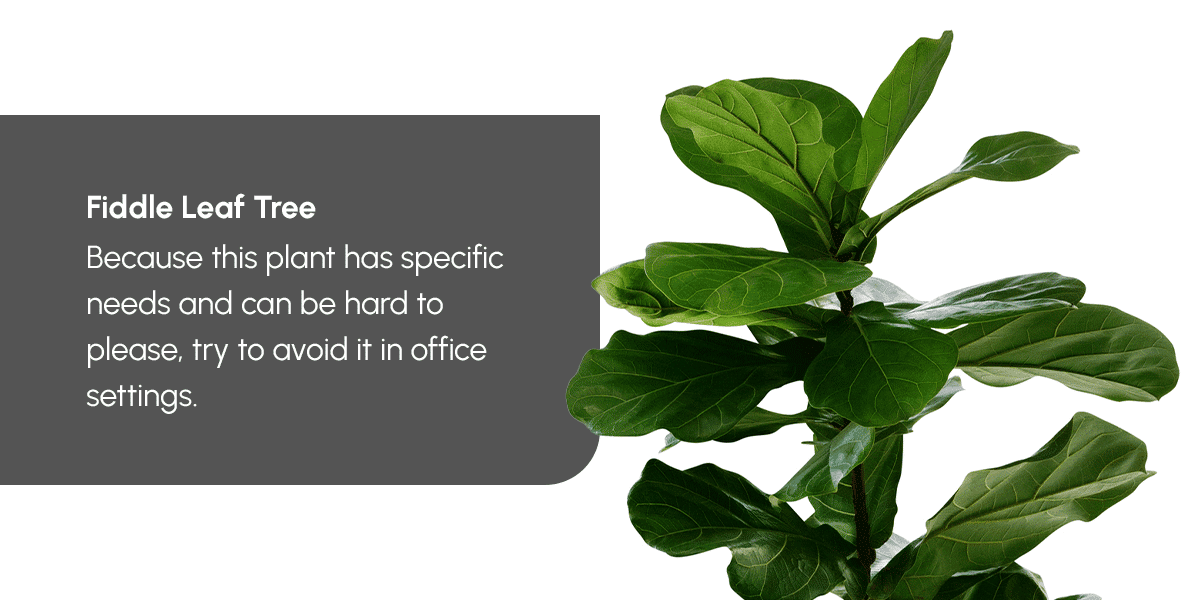
2. Fiddle-Leaf Trees
Fiddle-leaf trees can grow to become beautiful, large indoor plants if they’re correctly taken care of. Unfortunately, they’re among the hardest indoor plants to keep happy.
Fiddle leaf trees are extremely high maintenance, requiring the perfect soil, moisture levels, sunshine, and humidity. They also require a very humid environment, so unless your office is humid, you’d likely have to get this plant its own humidifier.
Because this plant has specific needs and can be hard to please, try to avoid it in office settings.
3. Orchids
Orchids are beautiful flowering plants that can make a statement in any space. However, some downsides to these plants make them less than ideal for an office. Orchids are quite high-maintenance, making them very difficult to keep alive.
You need a green thumb and a knack for these plants to keep them blooming and thriving.
They’re very picky about indirect sunlight and have an unreliable watering schedule, which makes it easy to overwater or accidentally forget to water them.
While other plants can tolerate drought, orchids won’t. Additionally, orchids can be more expensive, making them a gamble if you fail to keep them alive.
4. Flowers
Though many flowers are relatively easy to grow outdoors, they’re not ideal for office cubicles. Flowers can be a nice surprise in the office, but having them inside frequently can be bad for coworkers with allergies. Flowers like daisies and sunflowers are most often found in outdoor gardens, and when they’re brought inside, they bring high quantities of pollen with them.
Pollen is one of the most common causes of seasonal allergies, and many of your coworkers may struggle with their allergies enough outside of the office.
To be courteous, it’s best to grow flowers outside rather than in your cubicle.
How To Choose The Best Plant For Your Office
Knowing how to choose office plants is essential to picking ones that will thrive. Many factors affect how well plants grow or fit into an office.
Here are three considerations that will help you determine the best plant for your office:
Lighting in your office: Lighting is a big aspect of your office that should be considered. Do you receive high amounts of natural light, none at all, or somewhere in between? The amount of natural light will narrow your plant search because some plants need specific sunlight. The best plant for your office will have light needs that reflect what your office can offer.
Maintenance requirements: As we mentioned earlier, different plants have different maintenance requirements. Consider how much time you’re able or willing to put into maintaining your plants on top of completing your work. You may need to assign team members to care for certain plants to avoid neglect or overwatering.
Kids and pets: Another often overlooked consideration in choosing plants is the people and animals that will be around them regularly. Some plants are toxic if ingested by people or pets. If your work involves these groups, you should choose pet — and child-friendly plants.
How To Incorporate Office Plants Into Your Workstations
With an idea of what plants to incorporate into your office, you may still wonder how to arrange your office plants. The answer to that question will depend on what plants you choose and what type of office space you have.
However, here are some ideas to help get you started.
Add Tall Plants To Empty Corners
Corners can be challenging to decorate in offices, especially if space is limited. Luckily, plants can be a great way to add some decor to those empty corners when office furniture may not be an option. Tall plants like palms or dracaenas can be potted in a large pot that sits directly on the ground rather than on a table, desk, or cubicle.
These plants add height and variety to your workspace with minimal effort.
Build Living Walls
Consider adding a living wall if you’re looking for a more extravagant way to incorporate plants and nature in your office. Living walls take a variety of plants, from moss to ivy, and plant them in a wall, allowing them to grow on a vertical surface rather than horizontally.
Living walls are a sight to see and would be an impressive addition to any space.
Use A Variety Of Plants
Knowing how many plants you should have in your office might be tricky. Many would say the more, the merrier, but you don’t want plants to detract from your employee’s productivity.
Several plants are beneficial as long as they don’t interfere with operations, and having various plants creates more visual appeal.
Enhance Your Office Design With Arnold’s Office Furniture
At Arnold’s Office Furniture, we understand that the design and layout of your office can significantly impact everything from the functionality of your furniture to your employees’ productivity.
Designing the perfect office space can be a challenge. Luckily, when you purchase office furniture from us, we offer free design services to help you achieve your dream workspace.
For more information about our office cubicles, workstations, office furniture, and design service, contact us today!
Written by:
Alissa Ettorre
Alissa has over 25 years of experience in the office furniture industry. For many of those years, Alissa was a Senior Interior Designer. She then took her love of design and working with customers to the sales realm and has been dedicating her knowledge there ever since. Learn more about Alissa!
Planning a new office layout? Get our free 2026 Space Design Guide.